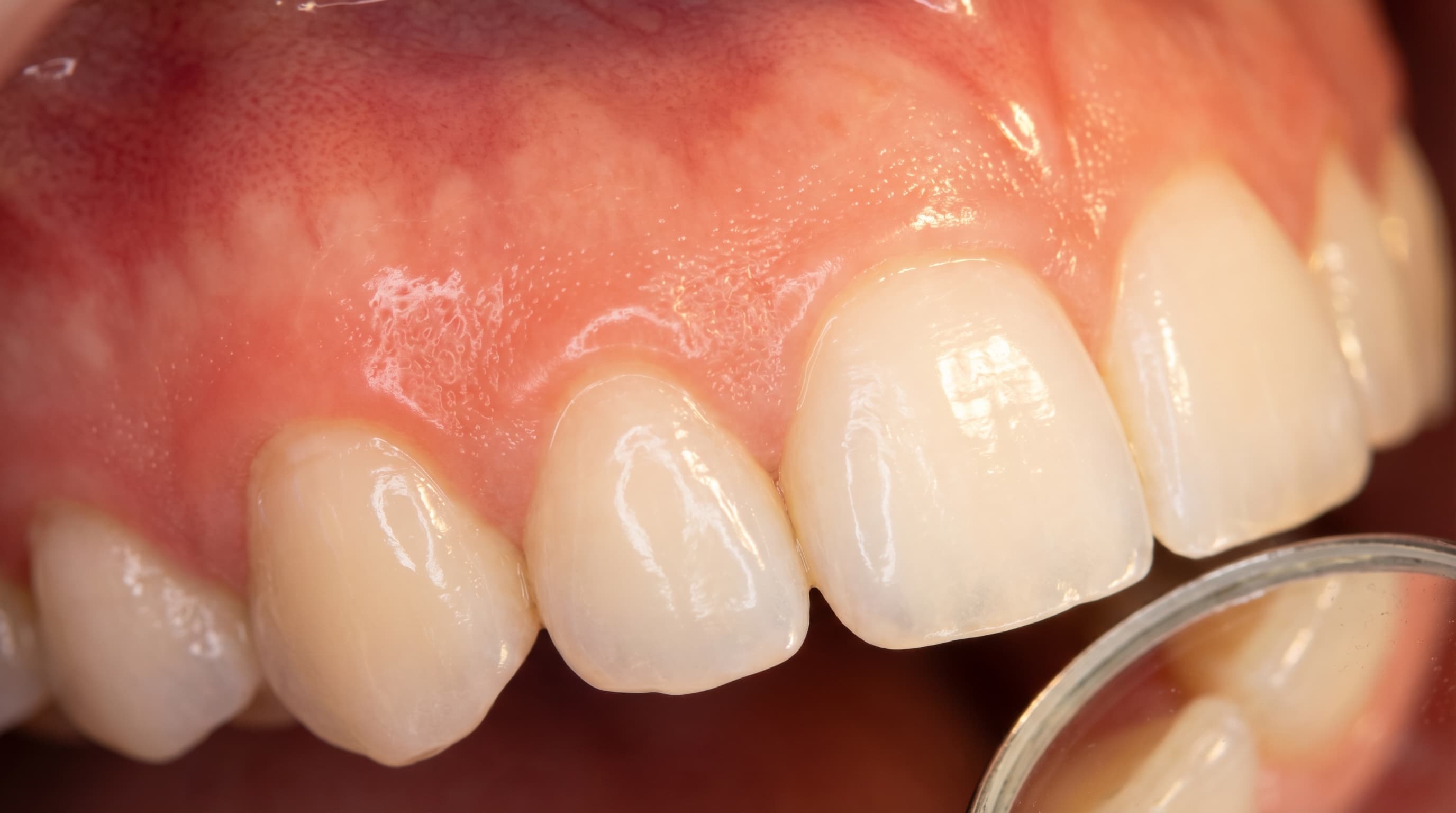
What Do Healthy Gums Look Like?
Your gums are the foundation holding your teeth in place. Most people never look at them closely - here's exactly what to look for and what it means.
Want a professional assessment?
Your Grin Score analyzes gum health from photos - checking color, recession, and inflammation. Get your free baseline.
Score My Grin - FreeThe 4 signs of healthy gums
Color: coral pink
Uniform coral or salmon pink. For darker skin tones, healthy gums may be brownish-pink or have natural melanin pigmentation - this is normal.
Red, dark red, purplish, or bright pink along the tooth margins indicates inflammation.
Texture: stippled (orange peel)
Healthy gums have a slight stippled texture - tiny dots resembling an orange peel. This indicates firm, well-attached tissue.
Smooth, shiny gums indicate swelling. The stippling disappears when tissue is inflamed and retaining fluid.
Shape: pointed papillae
The gum between each tooth (papillae) should be pointed and triangular, filling the space between teeth completely.
Rounded, blunted, or receded papillae indicate inflammation or periodontal disease. Black triangles between teeth suggest gum or bone loss.
Firmness: tight and snug
Gums should feel firm when you press them and hug each tooth tightly. They shouldn't move when you push on them.
Gums that feel soft, spongy, or pull away from teeth indicate disease. If you can fit a toothpick between the gum and tooth, the attachment is compromised.
The #1 test: does it bleed?
The simplest test of gum health: floss between your teeth and check the floss for blood. Healthy gums do not bleed from normal brushing or flossing. Any bleeding - even a tiny amount - indicates inflammation (gingivitis at minimum).
Think of it this way: if your scalp bled every time you brushed your hair, you'd see a doctor immediately. Bleeding gums deserve the same urgency - they're a sign of active bacterial infection.
Gum color decoder
Coral pink
NormalHealthy. Well-oxygenated tissue with good blood flow.
Pale pink / white
CheckMay indicate anemia, poor circulation, or hormonal changes. Can also be normal for some skin tones.
Red / bright red
WarningActive inflammation (gingivitis). Increased blood flow to fight bacterial infection.
Dark red / purple
UrgentSevere inflammation or advanced periodontal disease. See a dentist.
Yellow / white spots
UrgentPossible abscess (pus collection), oral thrush (fungal infection), or leukoplakia. See a dentist.
Gray / dark patches
CheckCould be melanin pigmentation (normal for darker skin tones), amalgam tattoo (harmless), or in rare cases, necrotic tissue. See a dentist if new.
Gum recession: the silent problem
Gum recession exposes the root surface of your tooth, which is softer than enamel and more vulnerable to decay and sensitivity. It happens so gradually that most people don't notice until it's significant.
How to check: Look at your front teeth in a mirror. Can you see a line where the tooth color changes (whiter enamel to yellowish root)? If the gum has pulled back from that line, you have recession.
Common causes of recession
Brushing too hard (the #1 preventable cause)
Gum disease (bacterial destruction of gum tissue)
Grinding or clenching teeth (bruxism)
Misaligned bite putting pressure on gum tissue
Genetics (some people have thinner gum tissue)
Tobacco use
How to keep your gums healthy
Brush gently at the gumline
Use the Modified Bass Method - angle bristles 45° toward the gumline with gentle vibrating strokes. The gumline is where plaque causes the most damage.
Floss or water floss daily
Plaque between teeth irritates the gum papillae. Daily cleaning prevents the inflammation that leads to gum disease and recession.
Don't smoke
Tobacco reduces blood flow to the gums, masks inflammation (smokers' gums may not bleed even when diseased), and dramatically accelerates bone loss.
Eat vitamin C
Vitamin C is essential for collagen production, which maintains gum tissue integrity. Deficiency causes gum bleeding and breakdown. Citrus, bell peppers, and broccoli are excellent sources.
Get regular dental cleanings
Professional cleanings remove tartar that home care can't touch. Tartar below the gumline is the primary driver of periodontal disease progression.
FAQ
Is it normal for gums to bleed when brushing?
No. Bleeding gums are always a sign of inflammation. The most common cause is gingivitis from inadequate cleaning. Start flossing daily and brushing at the gumline - bleeding should stop within 1-2 weeks.
Can receding gums grow back?
Unfortunately, no. Gum tissue does not regenerate on its own. However, a periodontist can perform a gum graft to cover exposed roots. More importantly, you can stop further recession by correcting your brushing technique and treating any gum disease.
Why are my gums dark?
For people with darker skin tones, melanin pigmentation in the gums is completely normal. However, if you notice new dark spots or patches that weren't there before, have your dentist check them.
How can I strengthen my gums?
Consistent gentle brushing at the gumline, daily flossing, adequate vitamin C intake, and professional cleanings. Massaging gums with a soft brush increases blood flow. Avoid tobacco, which weakens gum tissue.
When should I see a periodontist?
If you have: persistent bleeding despite good home care (2+ weeks), visible recession, loose teeth, deep pockets (your dentist can measure), or a family history of gum disease.
Get your gum health score
Your Grin Score includes a gum health dimension (0-15) that checks for redness, recession, and inflammation from photos. Track weekly to measure improvement.